Commercial Concrete Contractor Frisco for Concrete Slabs and Pads
When a commercial slab or equipment pad fails, the damage rarely starts with a dramatic https://ezlocal.com/tx/frisco/concrete-contractor/0919904899 crack. More often, it begins with something small and expensive: a door that no longer swings cleanly, a dumpster pad that settles at one corner, pooled water near an entry, or forklift traffic that exposes weak finishing and poor joint planning. By the time those symptoms show up, the root problem is usually buried below the surface.
That is why choosing the right commercial concrete contractor Frisco businesses can rely on matters more than most owners realize at the bid stage. A concrete slab is not just gray flatwork. It is the working platform for retail spaces, offices, warehouses, trash enclosures, generators, HVAC equipment, loading zones, and future tenant improvements. If it is poured with the wrong thickness, weak subgrade preparation, rushed finishing, or poor drainage, the costs do not stay isolated to the concrete. They move into operations, maintenance, scheduling, and liability.
In Frisco, where development continues at a fast pace and timelines can get tight, the temptation is to award the work to the lowest number and hope for the best. That approach usually looks cheaper on paper than it does six or twelve months later. A good concrete contractor brings more than labor and a truck schedule. They bring sequencing, site judgment, weather awareness, and the discipline to avoid the shortcuts that create callbacks.
What commercial slabs and pads actually need to do
A slab or pad has to carry more responsibility than most people give it credit for. In a small office build-out, it might simply need to provide a level, durable surface with clean saw joints and proper curing. In a commercial service yard, that same concrete may need to handle rolling loads, truck traffic, point loads from equipment, and constant exposure to water, oil, or cleaning chemicals. A generator pad, transformer pad, or dumpster pad has its own demands. So does a sidewalk connection to an ADA route.
That is where experience starts to show. A seasoned concrete contractor Frisco TX property owners trust will ask questions early. What is the use case? Is the pad supporting static equipment or repeated traffic? Is water expected to sheet across the surface? Is there a building tie-in where differential settlement could create an issue? Will another trade core through it later? Does rebar placement need coordination with anchor bolts or mechanical penetrations?
These are not small details. They shape base prep, reinforcement, concrete mix, edge treatment, control joints, slope, and cure time. When those decisions are made casually, the finished slab may still look fine for a few weeks. Commercial concrete often reveals its quality under load, through weather, and after real use begins.
Frisco conditions that affect slab performance
Frisco projects come with local realities that a contractor needs to respect. North Texas heat can accelerate set times faster than many owners expect, especially on broad open pours with reflected heat from nearby pavement or structures. A crew that is not prepared can lose the finish window quickly. That leads to surface defects, inconsistent texture, premature scaling, or crews adding water on site to buy time, which almost always hurts long-term strength and finish quality.
Then there is soil behavior. Parts of North Texas are known for expansive clay conditions, and while every site is different, slab performance depends heavily on what happens below the concrete. Poor compaction, wet spots, organic material, or unaddressed fill transitions can create settlement or movement that no amount of cosmetic patching will solve. Commercial jobs with utility cuts, trench backfill, or previous site disturbance need especially careful attention.
Drainage matters too. A pad with the wrong pitch may hold water against equipment bases or freeze-thaw vulnerable edges during cold snaps. A slab at a service entrance may push runoff toward a door if grades are not checked with the whole site in mind. Good commercial concrete work is not isolated from the rest of the property. It has to fit grading, access, adjacent hardscape, and future maintenance.
The difference between residential flatwork and commercial concrete
A lot of contractors can pour a driveway. That does not automatically make them the best concrete contractor Frisco for commercial slabs and pads. Commercial jobs ask for a different kind of planning and quality control.
The tolerance expectations are tighter in some areas and more performance-driven in others. Schedules are usually linked to multiple trades, inspections, deliveries, and occupancy dates. Reinforcement may need more careful placement. Slab edges often interact with steel, masonry, curbs, bollards, metal buildings, or storefront systems. There is less room for improvisation.
Commercial work also demands stronger communication. If the electrician needs conduit stubs in exact positions for equipment, or the mechanical team is relying on anchor templates, a missed dimension can ripple into major delays. A skilled commercial concrete contractor Frisco teams respect knows how to verify layout, confirm elevations, and raise concerns before trucks are dispatched.
I have seen projects where the pour itself went smoothly but the lack of coordination created rework that cost more than the original concrete package. One equipment pad had to be partially demolished because anchor bolt locations were off enough to affect the manufacturer warranty. The concrete was structurally sound. The problem was layout discipline. That is a painful way to learn that commercial flatwork is never just about placing mud.
Where slabs and pads fail most often
Commercial slab problems are usually tied to a handful of preventable mistakes. The surface crack gets the blame because it is visible, but the real cause often started earlier.
Subgrade preparation is a common weak point. If the base is uneven, undercompacted, or too wet, the slab may settle or flex. Reinforcement can also disappoint when it is specified correctly but ends up at the bottom of the slab instead of where it needs to be during placement. Joint planning is another area where poor judgment causes trouble. If joints are too far apart, too shallow, or cut too late, random cracking can take over.
Finishing practices deserve attention as well. Overworking the surface, sealing in bleed water, or rushing cure time can create weak top layers that dust or flake under use. On commercial sites with vehicle traffic, edge durability around joints and corners becomes critical. If those areas break down, the slab starts looking old long before its time.
A reliable concrete contractor near me should be able to explain not just what they build, but how they avoid these exact failure points. Clear answers are usually a good sign. Vague reassurance is not.
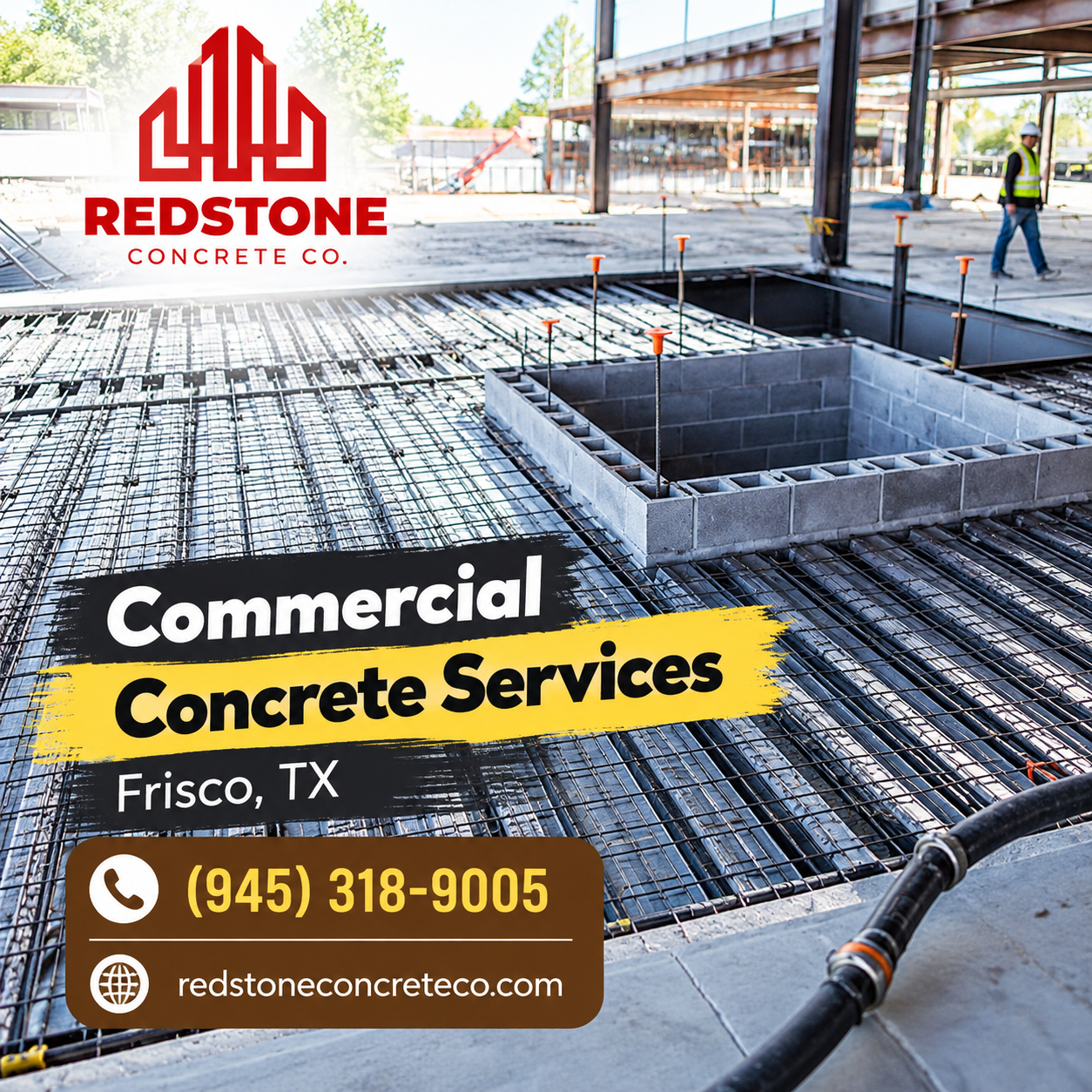
What a well-executed commercial slab looks like before the pour
The best slab jobs often look unremarkable during placement because the hard work happened before the first truck arrived. Forms are straight and braced. Elevations are checked. The base is compacted and trimmed. Reinforcement is supported properly. Penetrations, blockouts, and embedded items are confirmed against current plans, not last week’s drawings. Access for trucks and pumps is thought through so the crew is not making panicked adjustments with wet concrete on site.
For owners and property managers, that pre-pour discipline is worth noticing. A contractor who invests time in prep is usually protecting your schedule and budget. A contractor who wants to “figure it out on pour day” is inviting risk.
Here are a few signs the job is being approached professionally:
- The crew verifies subgrade condition and moisture before placement.
- Layout, elevations, and slopes are checked against surrounding site conditions.
- Reinforcement is chaired or supported instead of left to chance.
- Joint locations are planned with slab geometry and use in mind.
- Cure protection and saw cutting timing are discussed before finishing starts.
That short list is not glamorous, but it separates durable work from work that looks acceptable only from the street.
Concrete slabs for retail, office, and mixed-use properties
Frisco has no shortage of retail and mixed-use development, and those projects come with their own practical concerns. Front-of-house flatwork needs to be clean, accessible, and visually consistent. Back-of-house areas often take much harder abuse than the public sees. A restaurant service area may need pads for grease equipment, dumpsters, and delivery traffic. A medical office site may need a generator pad with precise utility coordination. A storefront renovation may require a new housekeeping pad for condensers where appearance still matters because it sits near visible pedestrian routes.
These jobs require balance. The slab has to perform, but it also has to fit the property’s image and operate around tenants, customers, or adjacent active construction. Timing matters. Noise control matters. Clean site management matters. So does limiting disruption to access and parking.
This is one reason many owners look specifically for a concrete contractor Frisco rather than simply taking a broad regional name from a search result. Local crews tend to understand permitting pace, traffic realities, supplier timing, and how quickly weather can shift on an commercial concrete services open site in North Texas. Familiarity does not replace skill, but it often supports better execution.
Equipment pads are small pours with big consequences
A common mistake is treating equipment pads like minor work. In reality, they can become some of the most unforgiving pours on a property. The footprint may be small, but tolerances are often tighter, and the consequences of error can be outsized.
Generator pads, transformer pads, HVAC pads, trash compactor pads, and loading dock approach slabs each come with unique demands. Some need smooth, level bearing for equipment installation. Others need stronger edges, isolation details, anchor embed accuracy, or protection from water intrusion. If the pad supports vibrating equipment, mass and stability can matter more than a casual observer might assume.
I have seen a compact mechanical pad delay a project because slope was not coordinated with the equipment base. The concrete looked neat. The installer could not set the unit as intended. Demolition and replacement followed, and the entire sequence pushed back inspections. The cost of redoing that small slab far exceeded what better planning would have cost on day one.
That is why the best concrete contractor Frisco Texas Redstone Concrete Co or any other reputable local firm should talk through exact equipment requirements before finalizing the work. Manufacturer details, anchor patterns, clearances, access paths, and finish expectations belong in the conversation early.
Scheduling around weather, curing, and other trades
Commercial concrete rewards patience in the right places and speed in others. You want a contractor who can move decisively without pretending the material obeys wishful scheduling. Concrete does not care that a tenant opening is next week.
In warm weather, placements may need earlier start times, extra crew coordination, or curing measures to keep the surface from drying too fast. In colder conditions, protection can become the deciding factor between a sound slab and one that struggles to gain strength properly. Rain can complicate base prep and finishing, but it should not automatically derail work if the site is staged intelligently.
Trade coordination is just as important. If plumbers are still modifying underground lines or electrical conduit routes remain unresolved, pouring anyway may create expensive saw cutting and patching later. A professional commercial concrete contractor Frisco owners trust will sometimes slow a job down for a day to keep it from slipping a week.
That kind of judgment can be hard to appreciate in the moment. It usually becomes clear only when a project reaches turnover without a stack of avoidable concrete issues.
Choosing the right contractor without getting lost in bids
Owners often search for a concrete contractor near me and get a page full of names that look similar at first glance. The challenge is sorting out who truly understands commercial slab work from who mainly handles light residential or one-off jobs.
Price matters, but bid review should go beyond total cost. Scope clarity tells you a lot. Does the proposal mention demolition, haul-off, base prep, reinforcement, formwork, finishing, saw cuts, curing, cleanup, and protection? Are assumptions stated clearly? Is there any acknowledgment of access limitations or phased work? A thin bid with a low number can become the most expensive option once change orders and repairs start stacking up.
It helps to ask direct questions in plain language. What type of base prep is included? How are slopes verified? How is reinforcement supported during placement? When are joints cut? What happens if weather interrupts the pour? Who is responsible for layout confirmation around embedded items or equipment anchors? Contractors who answer these questions comfortably have usually lived through the problems already.
If you are comparing companies such as Redstone Concrete Co against other local names, look for evidence of commercial discipline, not just attractive finished photos. Plenty of weak slabs looked great the day the forms came off.
Red flags property owners should notice early
Some warning signs show up before work starts. Others appear while the site is being prepared. Both deserve attention.
A contractor who cannot explain slab thickness, reinforcement logic, or joint spacing in practical terms may not be the right fit for commercial work. The same goes for crews that show little interest in grades, nearby drainage paths, or subgrade condition. If every concern is answered with “it’ll be fine,” that is usually not confidence. It is avoidance.
Watch the prep. If reinforcement is lying flat without support, forms are drifting out of line, or the crew seems unsure where penetrations belong, the pour should not proceed until questions are resolved. Stopping a bad pour is uncomfortable. Living with a bad slab is much worse.
Why local reputation still matters
Search terms like concrete contractor Frisco TX or best concrete contractor Frisco can generate endless options, but reputation in a local commercial market still carries real weight. General contractors, property managers, and developers remember which crews show up organized, communicate clearly, and stand behind their work when punch items arise.
That local memory matters because commercial concrete is rarely a one-time relationship. A property that needs one slab or pad this quarter may need another next quarter for a tenant expansion, trash enclosure, utility upgrade, or equipment replacement. Owners benefit from working with contractors who understand their standards and site history.
For that reason, phrases like best concrete contractor Frisco or best concrete contractor Frisco Texas Redstone Concrete Co should not be judged by marketing alone. They should be tested against scope clarity, project management, field discipline, and how the finished work performs after the rush is over.
A slab is only simple if the contractor makes it look that way
The strongest commercial concrete work usually draws little attention after completion. People walk on it, drive over it, install equipment on it, and move on with business. That quiet performance is the result of many decisions made correctly in sequence, from subgrade prep and slope planning to finishing and curing.
For commercial properties in Frisco, concrete slabs and pads are foundational in the most literal sense. They support operations, safety, drainage, access, and appearance. They also absorb abuse that owners may never fully see until something goes wrong. Choosing a capable concrete contractor is less about getting concrete placed and more about getting risk removed.
Whether you are evaluating a new site package, replacing a failed equipment pad, or planning phased improvements at an active property, the right commercial concrete contractor Frisco should bring practical judgment to every stage. That means asking better questions, respecting site conditions, coordinating with other trades, and refusing shortcuts that trade today’s schedule for tomorrow’s repair bill.
When that happens, the finished slab does exactly what it should. It stays level, drains properly, handles the load, and disappears into the normal life of the property. For commercial concrete, that is about as close to success as it gets.
Corrections
Spot something wrong? Send it to the desk and it gets fixed in the open.